
At the end of a long week in February 2015, after working an overnight shift as a gaffer and lightning technician on an independent feature film, Chris Walters fell asleep as he was driving home and totaled his truck. Walters, a lifelong Los Angeles resident who joined the entertainment industry right out of high school, was exhausted from consecutive days on set that wrapped late at night or early in the morning. While he was accustomed to such long hours, Walters says, his fatigue finally caught up with him that morning on Interstate 5. Nodding off, he drifted across lanes of traffic and hit a guardrail. Walters awoke to the sound of the crash and considers himself lucky to be alive.
“I’m very thankful that I’m able to tell that story,” Walters says. “Fortunately, when I fell asleep it was late enough, or I guess early enough in the morning, that there were very few cars on the road. I’m very, very fortunate that nobody else was involved in it.”
Walters, 37, has since left the industry, seeking more stability for his family. But at the time, he rationalized the accident as “just part of what it takes” to work in entertainment. “You just sacrifice yourself a bit,” he says. “ There [are] so many times when your eyes are so heavy, your windows are down, the radio’s blasting, you start laughing, and you just do anything that’ll keep you up.”
Working conditions are top of mind for Hollywood crew members following the death of Rico Priem on May 11. A day player working as a freelance grip on ABC’s 9-1-1, Priem died in a car accident on his way home from a 14-hour overnight shift that ended at 4 a.m.. According to the Hollywood Reporter, he had worked two back-to-back, 14-hour days. He was found dead at the scene on the 57 freeway, according to the California Highway Patrol, his car overturned.
While the crash is still under investigation, Priem’s passing struck a nerve with the production community as they continue to learn of crew members dying or suffering serious injury on the job. In February, J.C. “Spike” Osorio, a rigger working on Marvel’s Wonder Man series, died when he fell through a wooden catwalk, an incident that is also under investigation, in this case by the California Division of the Occupational Safety and Health Administration.
Deaths on set are not necessarily common. Statistics are hard to come by, but a 2016 report by the Associated Press cited at least 194 “serious accidents” on film and TV sets between 1990 and 2014, and at least 43 deaths. The topic garnered renewed attention after the tragic October 2021 death of cinematographer Halyna Hutchins (and severe injury of director Joel Souza) when Alec Baldwin misfired a prop gun on the set of the indie Western Rust. (The armorer on set, Hannah Gutierrez-Reed, has been sentenced to 18 months in prison after being found guilty of involuntary manslaughter. Baldwin, who pleaded not guilty to the same charges, is set to go to trial in July.) Many crew members also cite the death of 27-year-old camera assistant Sarah Jones, who was killed on the set of Midnight Rider in 2014 after being struck by a railroad train, as a galvanizing moment. Just last month, the Associated Press reported that several crew members were injured and two were hospitalized on the set of Eddie Murphy’s upcoming Amazon film The Pickup when a car and truck collided together.
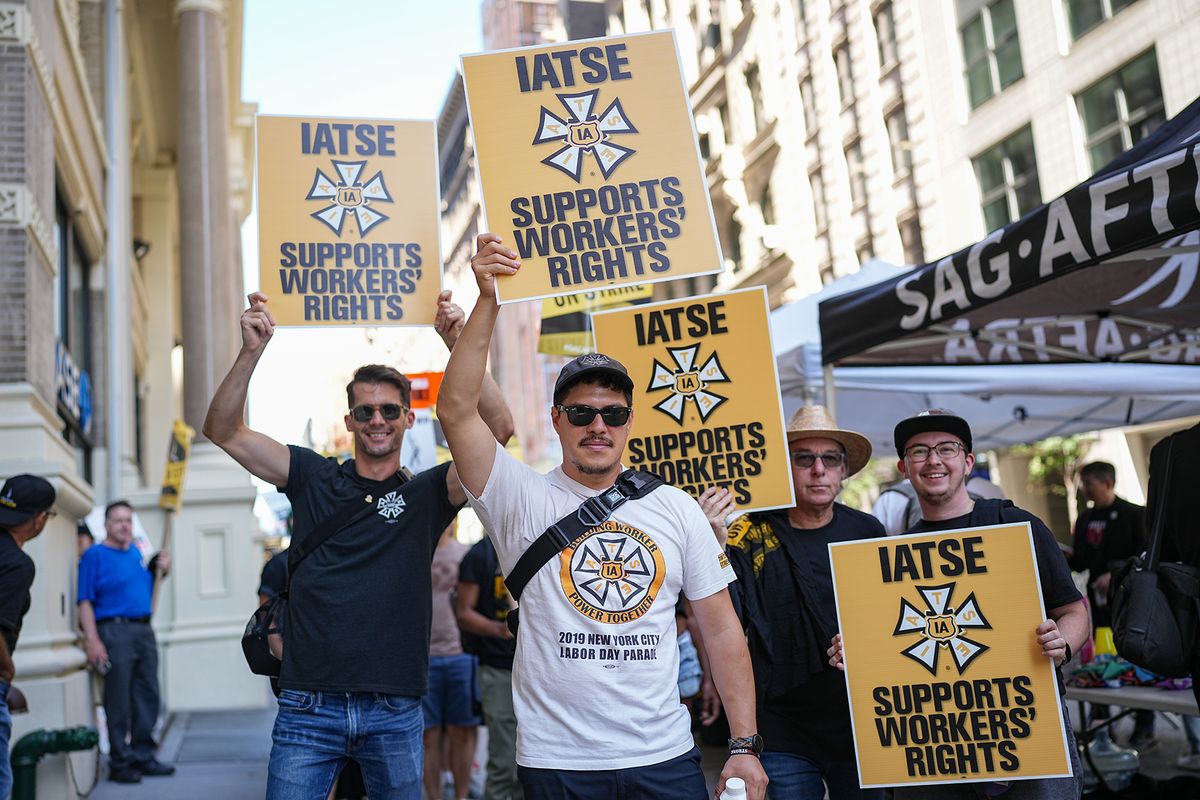
Safety is one of the main issues of concern as the crew members union, the International Alliance of Theatrical Stage Employees (IATSE), prepares to return to the negotiating table with Hollywood studios and streamers, represented by the Alliance of Motion Picture and Television Producers (AMPTP), in June to agree on a new contract. As reported by Deadline, IATSE is aiming to secure increases in wages and residual funding for crew members’ health and pension plans, establish a 401(k), and increase studios’ and streamers’ penalties if they violate rest period laws meant to protect crew members from overworking. The two groups last wrapped talks on May 17 after failing to reach a tentative agreement.
“Your wages don’t matter if you don’t make it home at night,” Malakhi Simmons, a lighting technician who is the vice president for the IATSE Local 728 and a part of the negotiating committee, tells Rolling Stone. “I think what needs to be changed is the culture. We have a culture in our industry where it’s like, ‘Just get it done and tough through it’…We need to change the culture of whoever’s scheduling these long days because with better scheduling, a lot of this can be avoided.”

There is some dissension within the IATSE, which has more than 170,000 members nationwide. A group of members who call themselves the Caucus of Rank-and-File Entertainment Workers, or CREW, is pushing for more transparency into the negotiating process. Last week, CREW published a petition signed by more than 700 people asking the union to provide details regarding the proposals and counterproposals that are being discussed throughout negotiations.
CREW was formed after many rank-and-file members voted against the Hollywood Basic Agreement in 2021, and even authorized a strike that never happened. The caucus is hoping to follow the lead of the writers and actors guilds, which provide detailed information to members about their proposals and let members vote on an outlined list of priorities prior to bargaining.
“We want to know all the details, because they lost our trust in 2021, and until they prove they can get popular contracts again, I don’t think they deserve that trust,” Greg Loebell, a lighting technician who helped write the CREW petition, says of IATSE leadership. “I’ve heard that they are fighting to make our working conditions safer, but I need to see results.”
Rolling Stone spoke to a dozen crew members who work across productions in Los Angeles and New York about their concerns regarding safety on set. All said they want the union to prioritize standardized safety inspections and limits on the length of a workday. A typical day on a TV or film set can range from 10 to 12 hours, but going beyond 12 hours is common. These extended workdays allow crew members to earn overtime pay and help them qualify for union health insurance and pensions. But some crew members who spoke to Rolling Stone say they shouldn’t need to work an exorbitant amount in order to make a living or receive benefits, forcing them to decide between their safety and their financial stability. The physical exhaustion of 12-plus-hour days also shouldn’t be underestimated, they say, especially considering they’re doing manual labor and then driving home usually later at night and sometimes far distances.
“There has to be a way that producers can find a way to still get what they need and produce great films but also realize that we are people,” Walters says. “With the hours we’re spending [working], they definitely make you push the limits.”
During negotiations for the 2021 agreement, IATSE won a mandatory 54-hour rest period over weekends, a measure intended to lessen the frequency of so-called Fraturdays, when members of production work late night Friday shifts that run into Saturdays. But the crew members who spoke to Rolling Stone say they haven’t seen much change around the practice, and it remains a concern in the current negotiations.
Peter Escobar has been a grip for the last two decades and most recently worked on the last few seasons of 9-1-1. He says that Fraturdays are a “necessary evil” for certain types of projects. “I work on a show about firemen and when are these rescues [on the show] supposed to happen, day or night?” he says. “A script is written primarily at night, so you have to shoot it at night. When I got into [the industry]… Fraturdays were already accepted. This is what you did and this is where you can make your money, in overtime.”
Escobar — who worked with Priem the day before he died and says the accident shook the whole cast and crew — hopes studios can account for the potential danger workers face when driving home late at night after a long day. Some crew members have suggested that studios should provide transportation home for crew in addition to decreasing their hours on set.
Ethan Ravens, who runs an Instagram account Production Assistants United, which aims to organize PAs across the industry, notes that production assistants are especially vulnerable when it comes to safety, considering they’re typically the first people to arrive on set and the last people to leave when filming wraps. They are currently not eligible to join a union, so aren’t protected by any IATSE rules and regulations.
Ravens says it’s infuriating that only a few months ago he was at a candlelight vigil in memory of Osorio and now the production community is mourning another loss following Priem’s death. “How many people need to literally die?” he says. “There’s no worse thing that could happen to you at work, or coming home from work.”
Loebell also worked on the set of 9-1-1 with Priem the day before he died. Having lost three colleagues he says he knew on a first-name basis in the last few years — Priem, Osorio, and Hutchins — Loebell says he’s reached a new level of frustration regarding the lack of safety in his business. He was especially unnerved by the death of Osorio, who he considered a mentor. Loebell says he hopes safety and inspections on set are standardized across different studios instead of how they’re currently managed, on a case-by-case basis.
“I suddenly felt incredibly unsafe being on a catwalk at any major studio in Hollywood [after Osorio’s death], and I still somewhat feel that way,” Loebell says. “Although there have been some individual inspections done of stages because various crew members complained, I would like to see legislation passed…[that would require] periodic inspections required of the catwalks. I don’t think the studios deserve our trust to police themselves in that matter.”
“Any day something could happen to me [on set],” Loebell continues. “I have a daughter who’s about to turn two. I would love to see her grow up and I’m scared I won’t.”






 Jean Jacket: Repull/Jewelry: Personal collection
 Hat: Xtinel/Dress shirt and vest: Raphael Viens/Jewelry: Personal Collection & So Stylé
  Dress: Helmer/Jewelry: Personal Collection
  Jewelry: Personal Collection
  Dress: Helmer/Jewelry: Personal Collection
 Catering Presented By The Food DudesPhoto by Snapdrg0n
 Catering Presented By The Food DudesPhoto by Snapdrg0n
 Catering Presented By The Food DudesPhoto by Snapdrg0n
 Photographer: Raphaëlle Sohier / Executive production: Elizabeth Crisante & Amanda Dorenberg / Design: Alex Filipas / Post-production: Bryan Egan/ Headpiece: Tristan Réhel
 Photo: Raphaëlle Sohier
 Photo: Raphaëlle Sohier/ Photo production: Bryan Egan/ Blazer:
  Photo: Raphaëlle Sohier/ Blazer: Vivienne Westwood/ Skirt :